
famous photograph by Robert Capa, The death of a militiaman , broke the English Civil War in the world (obtained from bibliocriptana.feles.worpress . com)
The July 18, 1936 part of the army took up arms against the Popular Front Republican government to establish a dictatorship led by General Mola in Navarra and General Franco in North Africa. However, the coup failed to dominate no large cities except Seville and Spain was divided into two areas facing.

banner with the famous slogan It will not in the C / Toledo (obtained from sp3.fotolog.com)
Radicalism scored in the dispute, as it focused on the war as a struggle between fascism and communism. The National Bank was supported by the army, the traditionalists (Carlist), the Falange fascist party and the support of the Catholic Church. The Republican side was overwhelmed by the activities of trade unions (CNT and UGT) and leftist parties (PCE, POUM). the Crusade was against the Revolution.

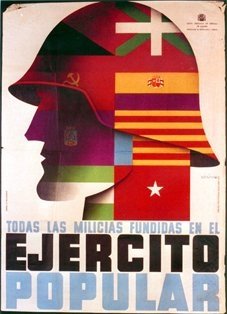
Posters calling phalanx warfare (rayosycentellas obtained. net) and Republican militias (imag.lecturalia.com)
International intervention strengthened the confrontation between fascism and communism, as General Franco was a major military aid and equipment Fascist Italy Mussolini (CTV) and the Hitler's Germany (Legion Condor), while the Republican administration got support from only Soviet Union of Stalin and the Communist volunteers of the International Brigades.

Parade in honor of Nazi troops of the Legion Condor (obtained from concejoabierto.file.wordpress.com)
The war was initially developed with the aim of the rebels to win Madrid, where there were the battles of Jarama, Guadalajara, Brunete. But it was impossible to get the war more forcefully moved to other fronts: the north of Spain fell to Franco in 1937 and early 1938 after the Battle of Teruel the National isolated Catalonia. The Republicans tried to fight back in the summer of 1938 at the Ebro, where the battle occurred bloody war, but that was the beginning of the end, because after it, in the winter of 1938/1939 was conquered Catalonia and the Republican defeat was imminent, and occurred on April 1, 1939.

Map of the evolution of the Civil War 1936-1939 (obtained of usuarios.multimanía.es)
called the first days of the National Uprising were very bloody because both sides pursued a terrible repression against its potential enemies. Were murdered without trial and leaving the bodies (trade unionists, religious, political, prominent persons from each side ...) in the gutters of roads and cemeteries, but even worse is that this situation was extended to areas that changed hands during the war . One of the most popular paseillo of this repression was the shooting of Federico García Lorca in Granada at the hands of the Falange.
Trailer for the film Death in Granada that shows the end of Federico García Lorca
in the war also developed other terrible tragedies such as starvation that was passed in the cities, where bugs lentils with potatoes and citrus was a delicacy. Also horrible were the indiscriminate bombings on the Republican zone, the cities of Madrid or Barcelona, \u200b\u200bbut which highlighted the destruction of Guernica.
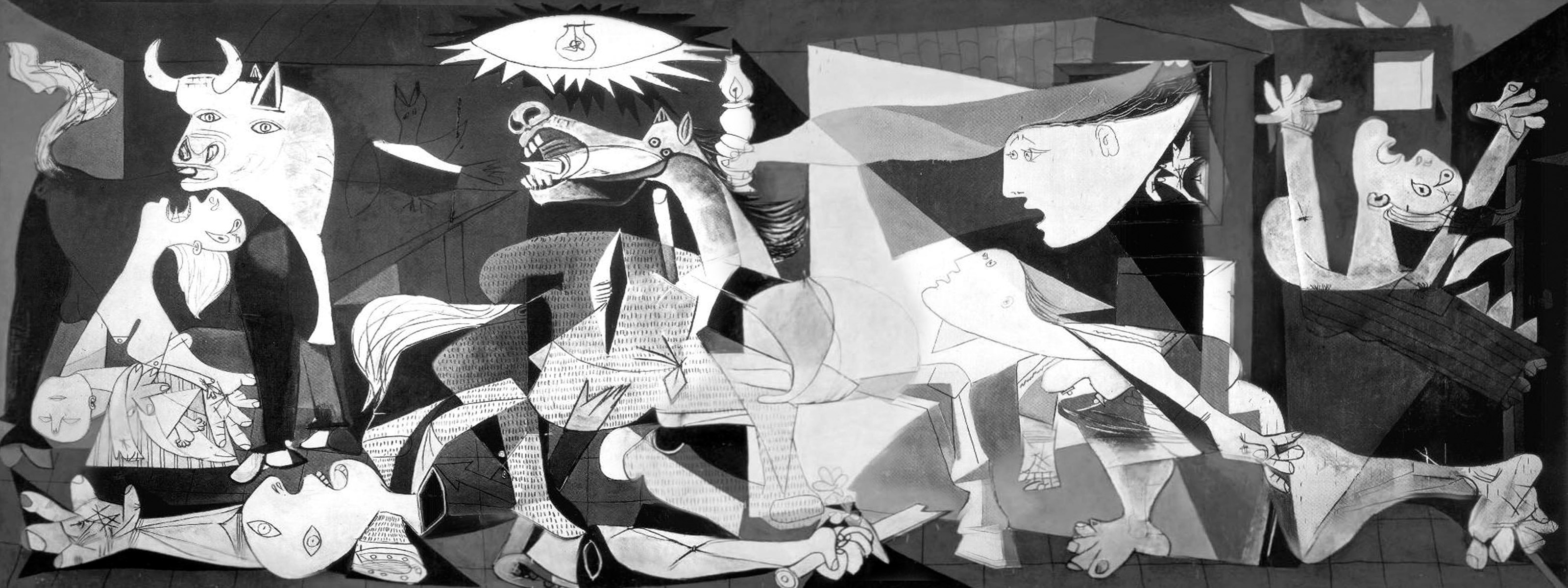
The Picasso Guernica, a symbol of civilian suffering, portrays the bombing of the city (1937) (obtained from chekinaddicts.files.wordpress.com)
Intellectuals in the Civil War were identified mainly with the republic, among them was Miguel Hernández that enlisted in the 5th Regiment where he became culture commissar actively working to raise morale of the soldiers, reciting and writing, of this period are Wind Village (1937), Pastor of death (1938) and as more resigned in defeat lurks Man (1939).


Photo of Miguel Hernández addressing soldiers and the International Brigades (obtained from elpais.com) and 5 th Regiment Poster communist (obtained from 2.bp.blogspot.com)
The consequence of the involvement of many, some intellectuals in defense of the republic was the harsh repression suffered by the Francoist side after the war, shot or imprisoned in appalling conditions to a large number of people. To avoid the majority opted for exile (Antonio Machado, Luis Buñuel, Rafael Alberti ...), as well as political, military, doctors, teachers, etc. Miguel Hernández tried in vain to flee to Portugal, but was locked , sentenced first to death, then commuted to 30 years in prison, where he eventually died in 1942 .


0 comments:
Post a Comment