Sunday, April 11, 2010

Kitchenaidtoronto Store

visited art source

see in art history from a perspective that examines the historical context, its technical characteristics, ideological, its message, its intent, etc., but many times more impact when we produce the artwork is seen on the site for which they were created rather than within a museum (and very educational it is) or a slide in class.

Box Velázquez Las Meninas (obtained from the website of the Ministry of Education)

For example, see the large oil painting of The Meninas of Velázquez in the Prado Museum is impressive, but imagine seeing it hanging in the very rooms of the Royal Palace of Madrid, with its high ceilings, surrounded by original furniture and other works would have been a unique experience.

Similarly analyze a work of art, for example, a given table as opposed to physical framework itself represents something can make us feel more and assimilate a number of nuances that we have never felt , despite having seen that picture on numerous occasions, for example the light there, colors, etc.
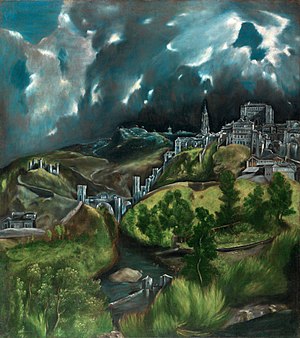

's View of Toledo El Greco (obtained from wikipedia), where it recreates the River Tagus at Toledo, and photograph of the bridge during the visit of two of ESO in March 2010.


Recently the students of 4 º ESO Country Real have returned from study tour south of France, and as no! have enjoyed, shared and learned, so much of themselves as the places they have passed. Our boys have visited Arles , beautiful city that has been for the history associated with the figure of Vincent Van Gogh , because it was there where he developed many of his works and many of the best known, so I suggest you do some comparing them with reality and with some recreation (the photos are from my trip to France in 2007, but admit any of those of you !!!).

Van Gogh's Room at Arles Van Gogh 1889 (image obtained from dpufog.blu.livefilestore.com)

Juanjo in Van Gogh's room, recreation I could see in Arles

Look at the furniture (wicker chairs, china on the table, clothes hanging ...) and perspective distortion introduced Van Gogh in his painting , from his unbalanced state of mind and announces a break with the formal art entailing the emergence of the avant-garde early twentieth century.

Patio hospital of Arles, Van Gogh 1889 (image obtained from fisterra.com)

Cristina and Juan in the courtyard of the hospital in Arles, 2007

the same place more than a hundred years later Is not this the same? Emphasizes the representation of colors flowers with a touch too loose (inherited from Impressionism), but large, typical of the particular style of Van Gogh.

Cafe Terrace night, Van Gogh 1889 (image obtained from todocuadros.com)

Cristina, Raquel and Juan at the Café du Soleil / Van Gogh (the same as the painting of Van Gogh)

note is the similarity of colors and moods, and although the picture is a night image under gas light and the photo is the full light of day, it still maintains its bohemian.

As you see, sometimes we have the opportunity to enrich the knowledge of art in situ, something that often leaves us usually much more track than a viewing slides in the classroom audiovisual. I hope you will encourage travel and prove that art and history are a great way to enjoy life.

Wednesday, November 4, 2009

Muscle Milk Wholesale

Napoleon Bonaparte: The character makes history or history makes the character? Two new bloggers

Napoleon Bonaparte (1789-1821), as Alexander the Great or Julius Caesar, is one of those characters that are said to make history in the sense that their events such as military ruler, had a great influence in his time, is something that the wars of the early nineteenth century Napoleonic Wars are called , besides its importance exceeded its time, being analyzed or criticized remembered having marking subsequent events as the Congress of Vienna and the Restoration Europe.

However, military prowess, diplomatic maneuvering and political measures of Napoleon in Europe in the early nineteenth century, as well as other historical figures were not coincidental but a combination of the historical context in which they lived and their personality. In this article I will focus on the aspect of his personality.


Equestrian Portrait of Napoleon Bonaparte (obtained from historiageneral.com)

Born into a wealthy bourgeois family Ajaccio (Corsica), his father was a lawyer but he had some land and commercial businesses, aiming to achieve a title of nobility to his family, Napoleon was the second of eight children Buonaparte, although the predominant position of his family in front of guys or cousins, linked to service a number of servants and servants strengthened their sense of hierarchy and authority. That goal was endorsed family climb when Napoleon divided his conquests among his brethren in Europe, rewarding them with thrones in different regions, as ; Joseph Bonaparte King of Spain (1808-1813).

Portrait of Napoleon and his family (obtained from oceansbridge.com)

However, soon had to deal with internal difficulties entering the ten years in a military school in the Champagne region with a scholarship, completing his military studies in Paris, away from his family and his environment Corsican (initially despised the French mainland to believe that oppressed the people of Corsica) with the only company his older brother Joseph. The following years he lived under a harsh discipline, surrounded by fellow leading families who laughed at his Frenchman with an Italian accent, taking refuge in her interest in geography and mathematics, all increased their sullen attitude and lonely, but he made a great strength of character.


Napoleon leading his troops in the Battle of the Pyramids, Egypt (obtained from kalipedia.es)

excelled in school not because finished No. 42 of 58 in his class in 1785, which after graduation toured some destinations unattractive and routine military. However, this period was instrumental in its future, as with military tactics books had time to complete his intellectual training with the reading of works of Rousseau , Voltaire, Mirabeau ... inquiring about human feelings and forms of government, which would bring him to the revolutionary ideas that erupted in 1789, although not aligned with any political group, had sympathy with the Jacobins (which will be detained and have cost his military rank after the coup of Thermidor in the summer of 1794).


Napoleon directed the coup of 18 of Brunario of 1799 (obtained from yesicai.blogspot.com)

The Revolution offered the opportunity he needed the ambitious Napoleon ( genius is the art of the opportunity said), and stressed in his military role in different events, taking Toulon or defense of the Convention against the royalists in the Tuileries, which allowed him to begin his successful career to lead the French armies in the campaigns of Italy and Egypt, which finally would become Emperor of France.


portrayed Napoleon all the symbols of the Emperor (obtained from internetstones.com)

As Napoleon was a brilliant military tactician, innovative tactics (especially on the mobility of artillery and infantry), meticulous in quartermaster, experienced in intelligence and skilled in diplomacy, all benefited from his tireless work capacity and proximity to the troops. As a politician was characterized by its dual aspect, appearing as a liberator against the old regime, extending some achievements of the Revolution (eg Napoleonic civil code) or ensuring principles such as merit and otherwise repressing national freedoms, limiting political participation in France and trying to dominate Europe militarily.

Equestrian Portrait of Napoleon characterized as the work of Gross Hannibal (obtained dewikipedia.org)

pride, ambition and self-confidence marked personality Bonaparte, but also the intelligence, courage and tenacity, all forged from his childhood in Corsica and his education in military academies, was increased and strengthened by his military successes, coupled with the glorification of a nation that did not stop political lurch and needed a strong leader.

To learn more about the biography and personality of Napoleon Bonaparte: http://www.artehistoria.jcyl.es/historia/personajes/5602.htm


Tuesday, November 3, 2009

Wood Tv Stand Blueprints

Real

As you may have already seen in the bar of links to blogs, there are two new posts at the SIES Campo Real. Both Curro (technology) as Ana (plastic) have opened their pages with interesting work and high quality, approached from a multidisciplinary perspective, which we announced a year full of surprises in the network, it will always willing to learn in these directions: